
MONTEZUMAThe Tactical War Council
Wargame the decision before you make it.
Proof of which options work, what each defeat costs, and who decided what, on what data. Built by Aztech, a service-disabled veteran-owned small business.
Proof of which options work, what each defeat costs, and who decided what, on what data. Built by Aztech, a service-disabled veteran-owned small business.
Tabletop exercises still run on spreadsheets, scripted red teams and someone's notes. The result is an opinion. MONTEZUMA turns the same exercise into evidence: options that were actually fought, an opponent that actually adapted, and a record of every call.
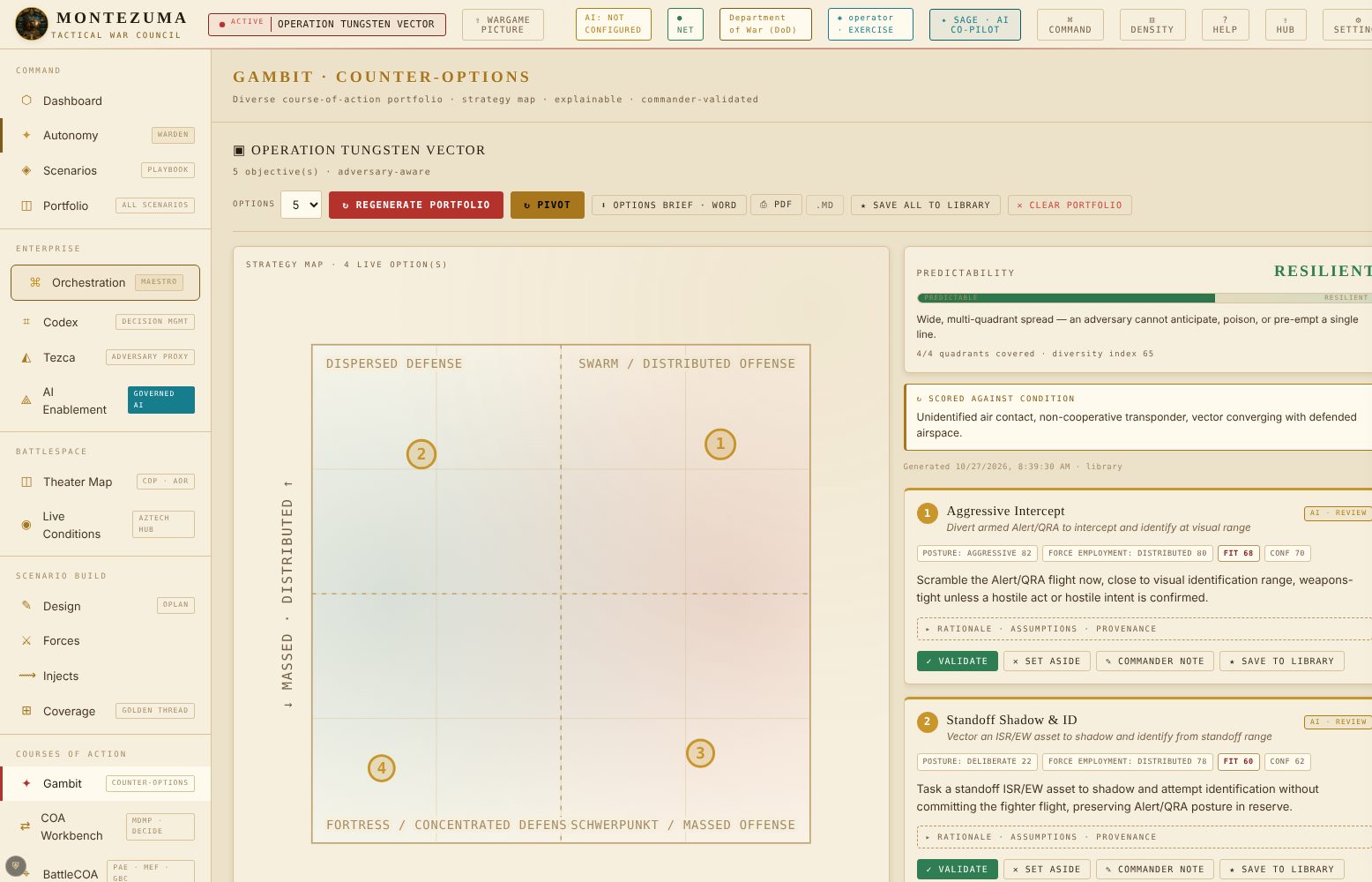
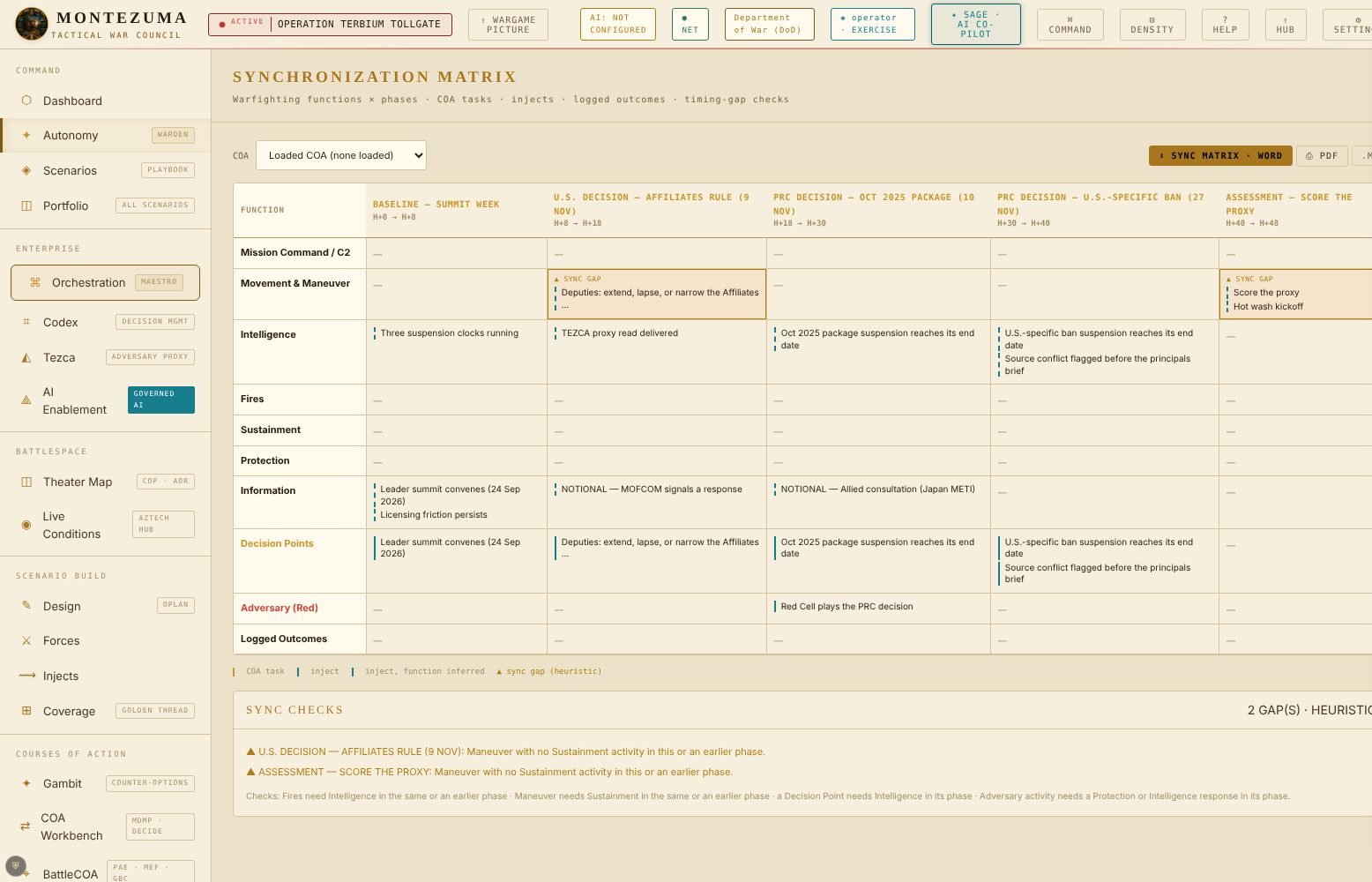
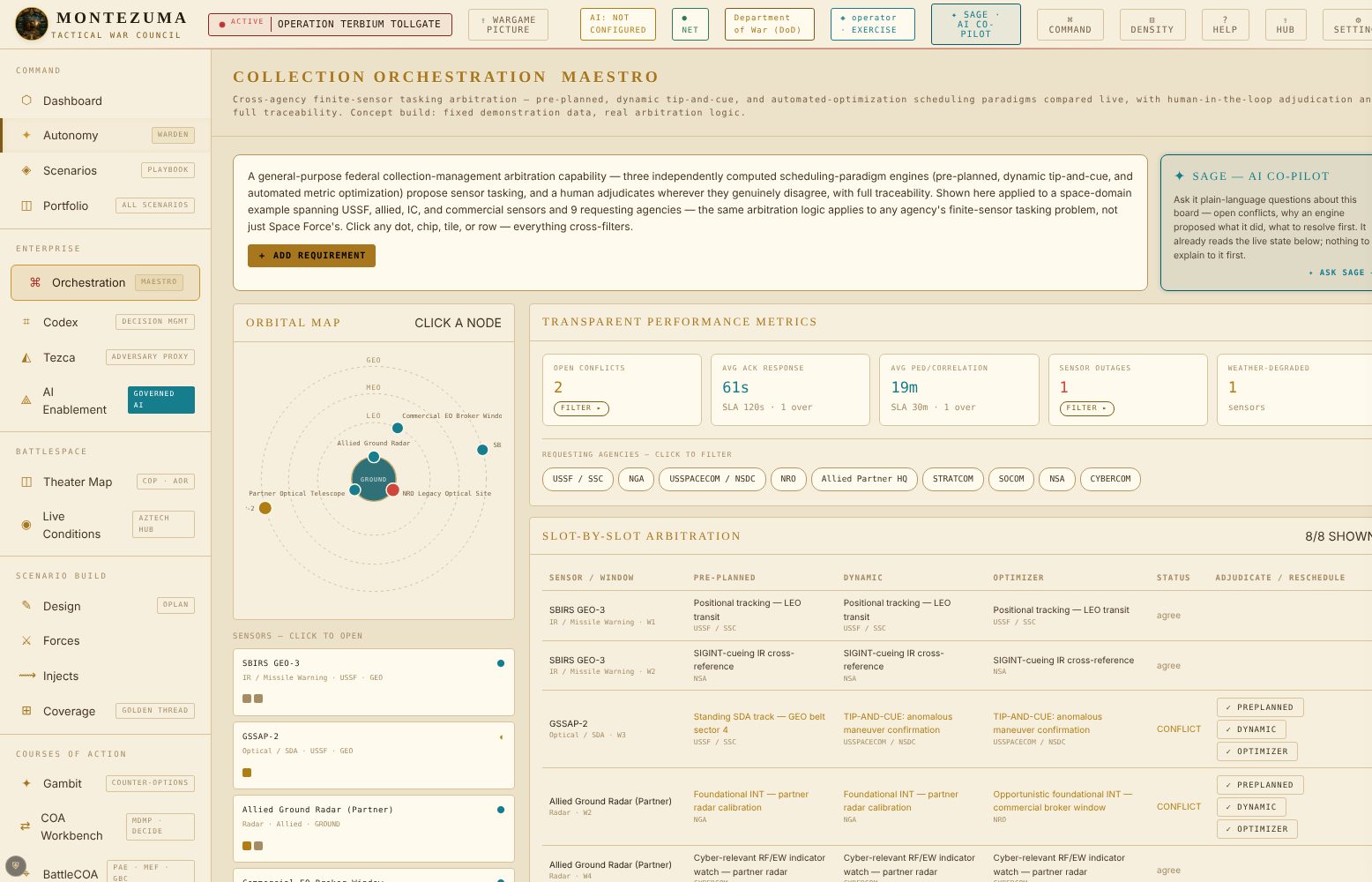
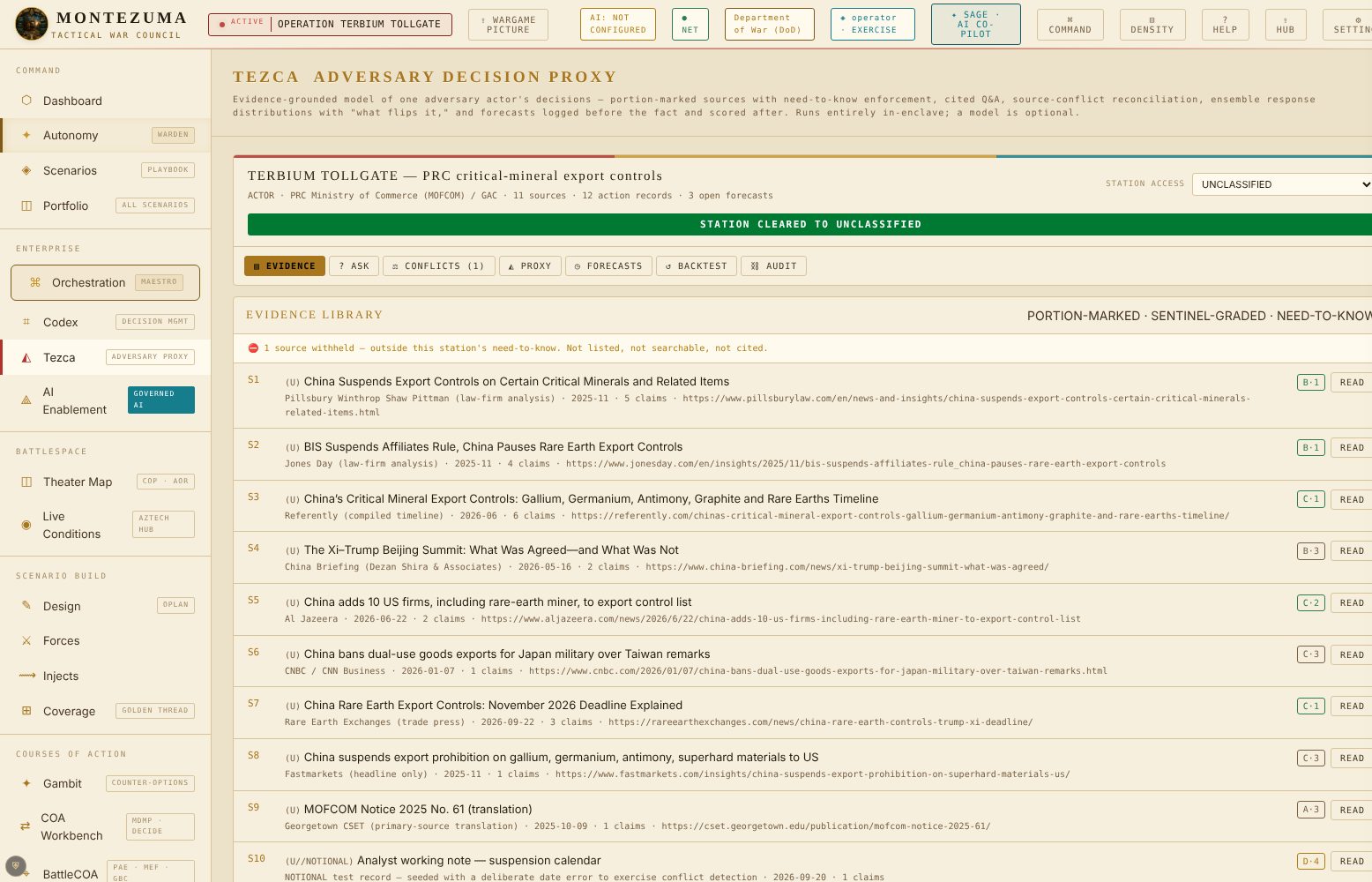
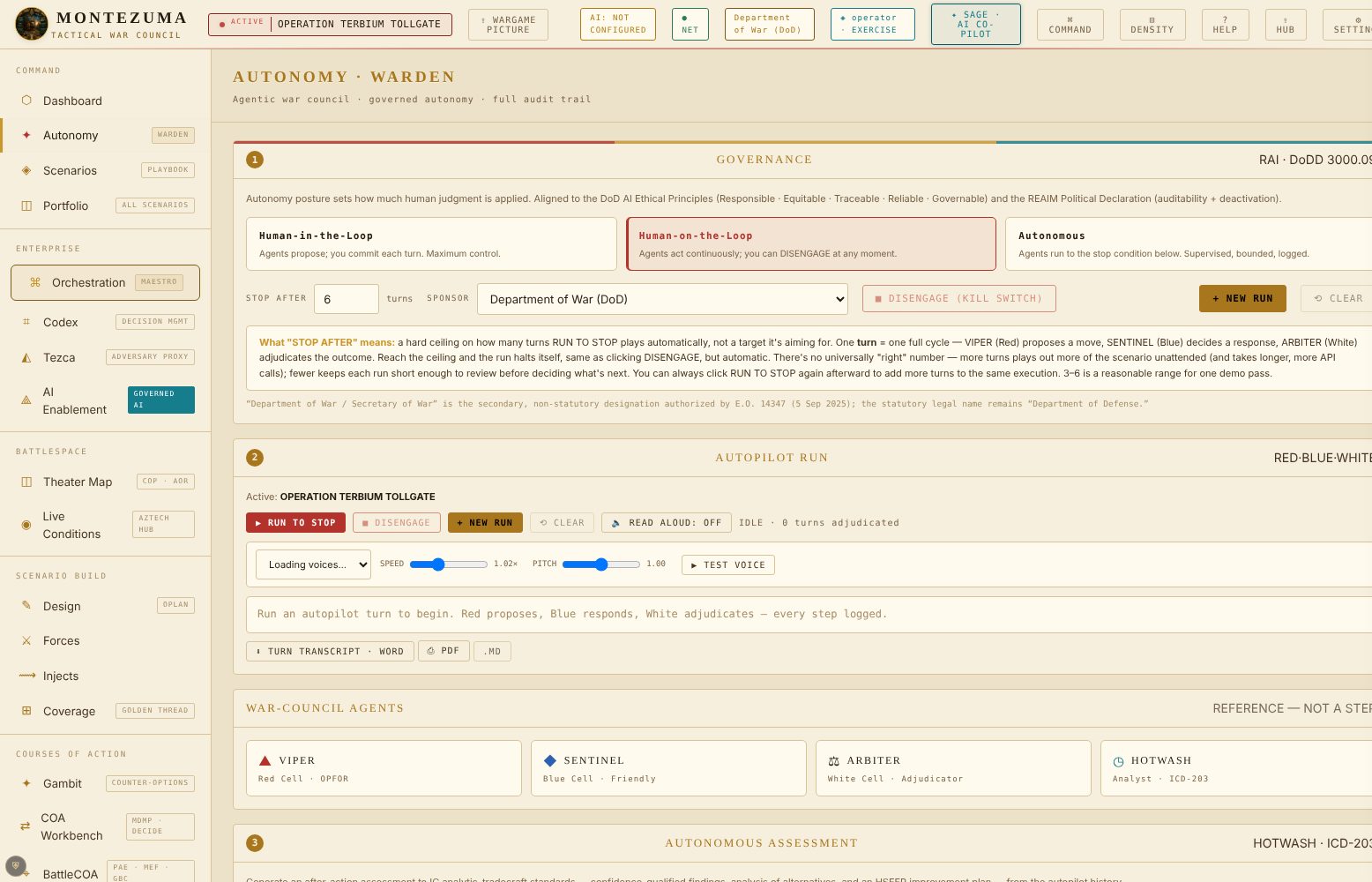
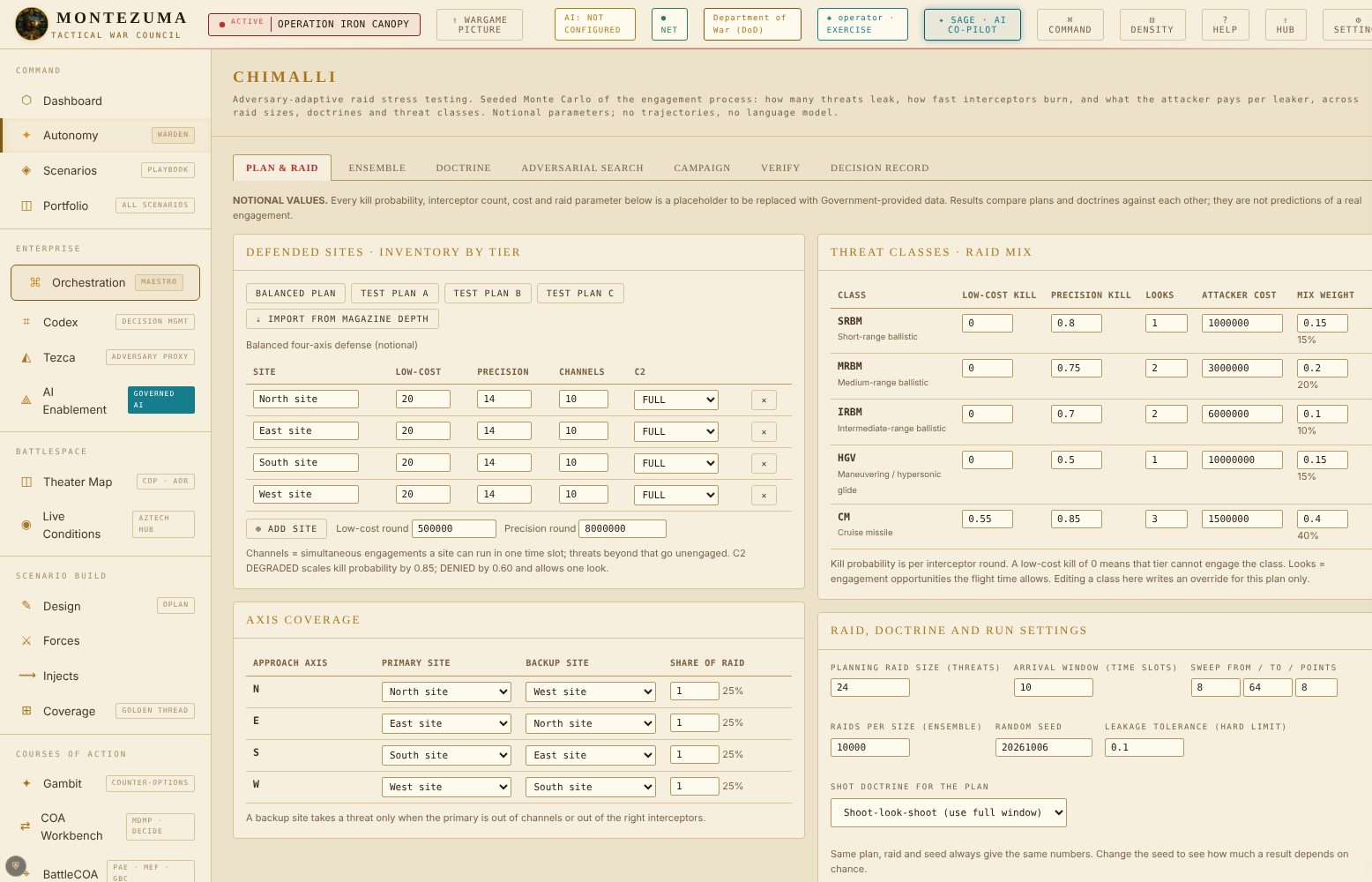
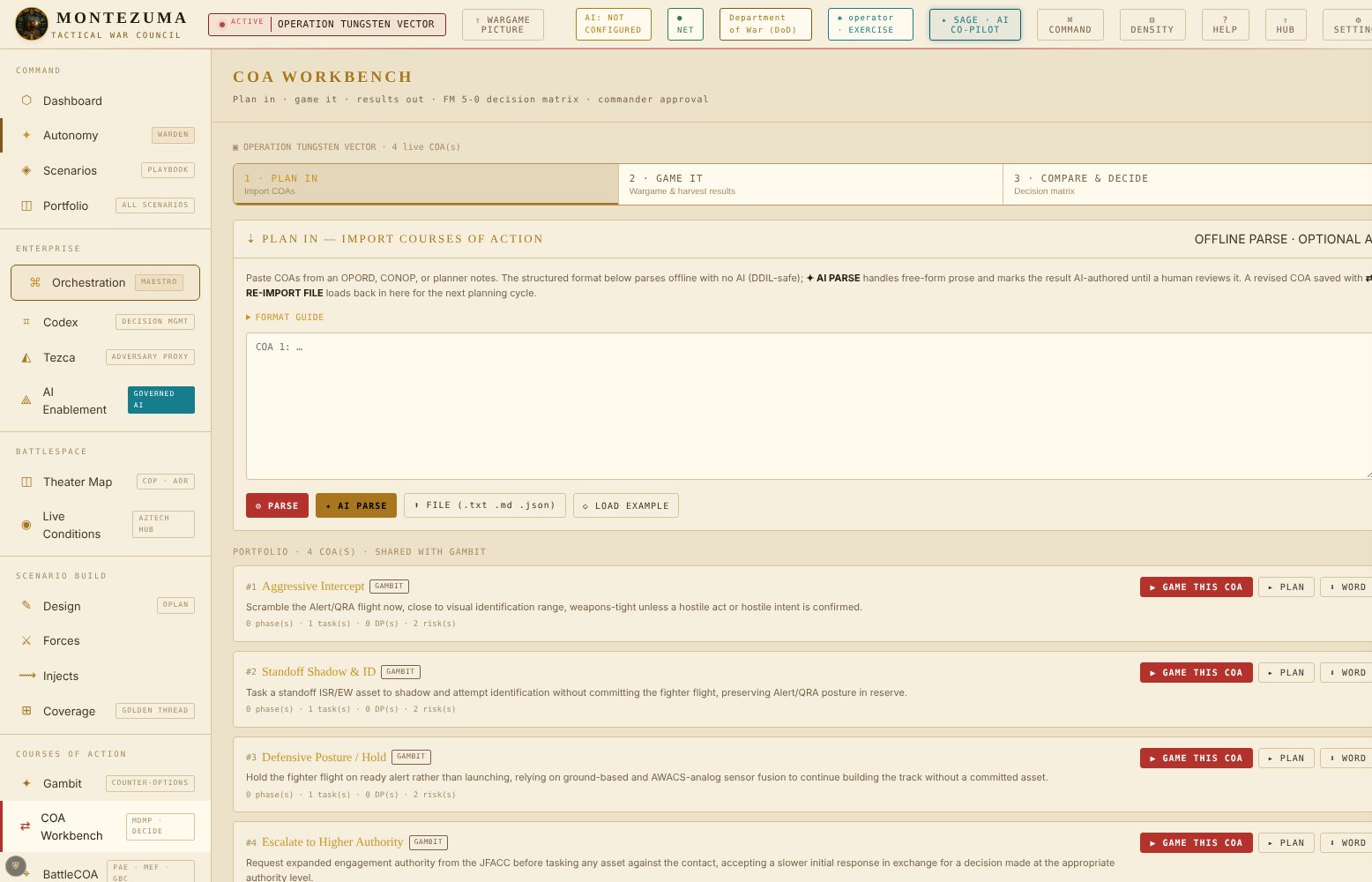
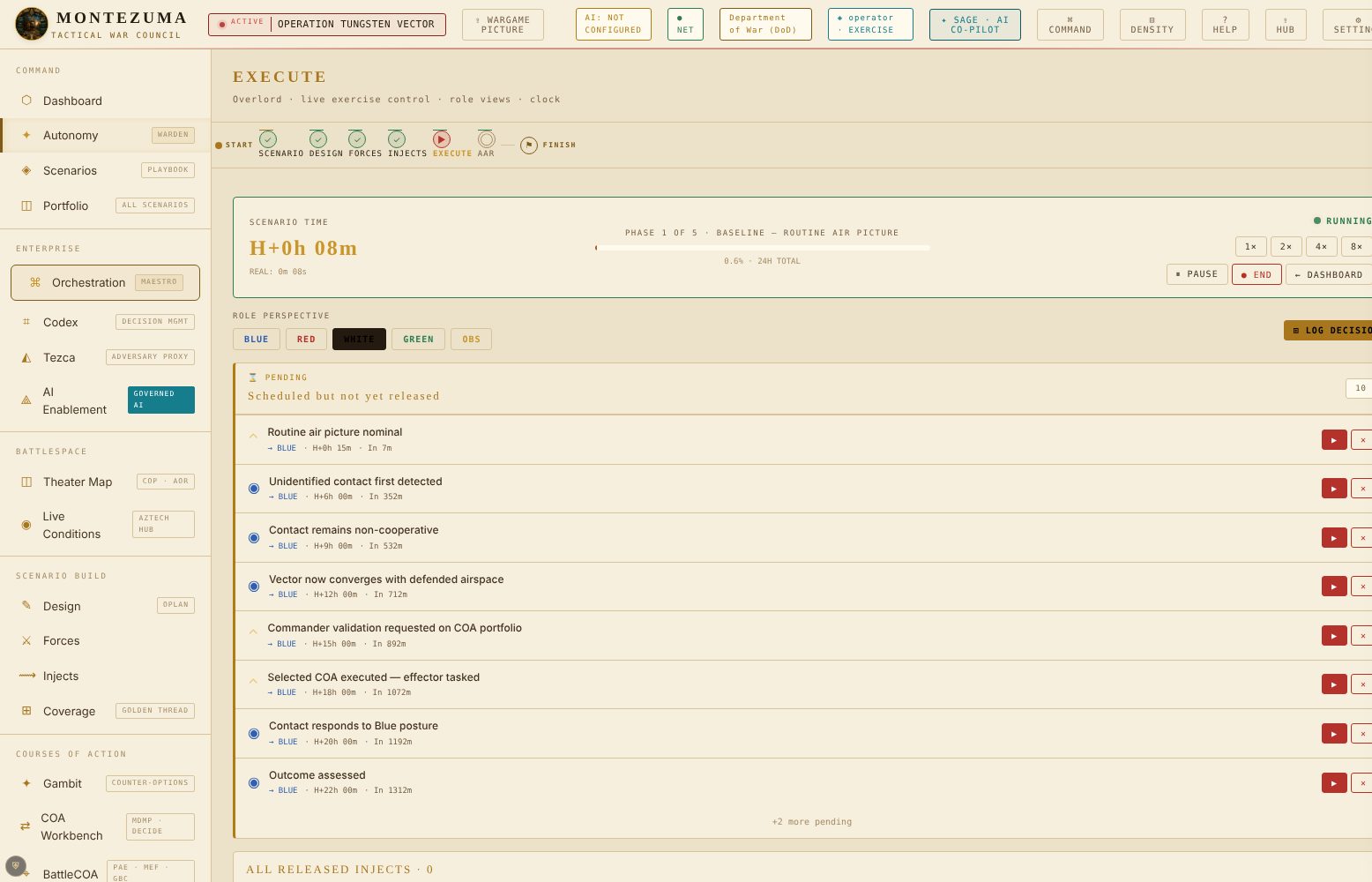
This is MONTEZUMA's real navigation. Pick any module to see the screen and what it does for your staff. The highlighted ones are what set it apart.
Most tools stop at moving pieces and rolling dice. MONTEZUMA models what commanders actually run short of: information, interceptors, throughput and the systems the mission rests on. Try each one below. They run on example values modeled on MONTEZUMA's scenario templates.
Four red units are concealed on this board. Blue and red each see only what they've detected. Pick a search method, then click a hex to search. Woods make units harder to find.
Click any hex on the board to search it.
A forward base holds 8 low-cost interceptors at $2,000 each and 3 precision interceptors at $400,000 each. Cheap ones fire first. When both are gone, drones get through.
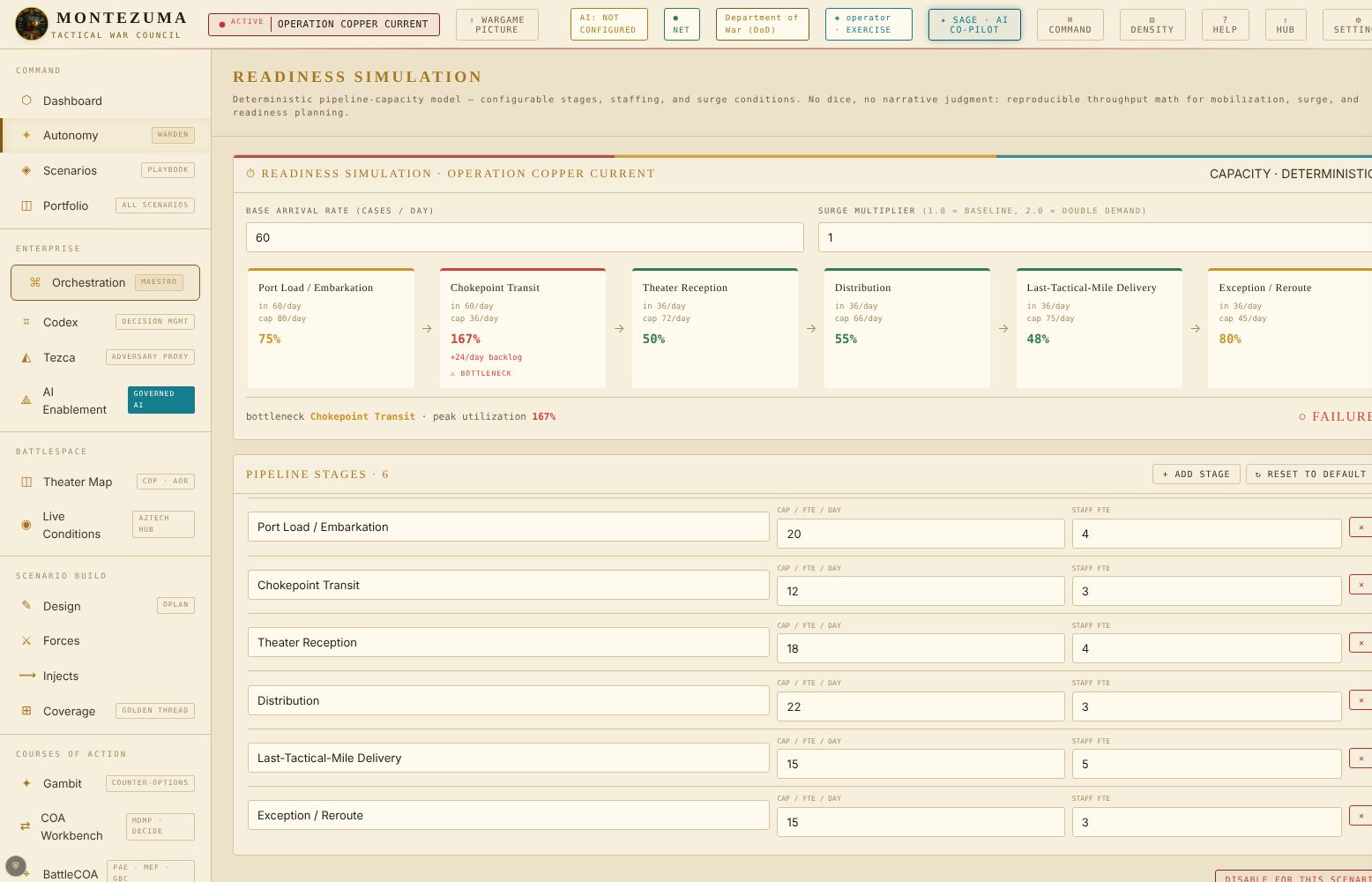
Cargo moves through six stages from port to the last tactical mile. Raise the daily demand and watch which stage fails first. Then add escort capacity at the chokepoint.
One objective rests on three tasks and seven systems. Sealift needs both the fleet and the port; airlift needs either aerial port; distribution needs two of its three routes. Click a system to degrade it, click again to take it down, and watch the status roll up to the mission.
Click any system on the left to change its status.
Every exercise ends in documents your staff can use the same day.
COA 2 holds the strait with the lowest risk to force. Recommend approval with a northern screen as branch plan.
| Risk | Time | Score | |
|---|---|---|---|
| COA 1 | 41% | ||
| COA 2 | 68% | ||
| COA 3 | 33% |
COA 2 holds the strait with the lowest risk to force. Recommend approval with a northern screen as branch plan.
| Risk | Time | Score | |
|---|---|---|---|
| COA 1 | 41% | ||
| COA 2 | 68% | ||
| COA 3 | 33% |
| Capability | Rating |
|---|---|
| Operational coordination | Met |
| Intelligence and information sharing | Partly met |
| Logistics and supply chain | Not met |
Pre-position escort assets at the chokepoint before Phase 2. Owner: J4. Due before next iteration.
| Time | Inject | To |
|---|---|---|
| H+02 | Port restriction announced | J4 |
| H+05 | Surface group leaves port | J2 |
| H+07 | GPS degraded in strait | J6 |
| H+09 | Drone raid on forward base | J3 |
| H+12 | Ally requests escort | J5 |
Nine minutes, start to finish: a short introduction to Aztech, then Operation COPPER CURRENT played through injects, Mission Web, key terrain, Futures, what-if branches, execution with staff advisers, adjudication and the after-action report.
Aztech was founded by Jeremy Bracamontes, a Navy veteran with a SOF SIGINT and targeting background and 26 years supporting SOCOM, the Department of War, the Intelligence Community and federal civilian agencies.
MONTEZUMA comes out of that work. It is built for the people who plan, run and assess exercises, not for a demo floor, and it changes based on what operators tell us after they use it.
Bring a problem set. We'll build it on the board and fight it with you.